May 2026
Our paper "Do Good, Stay Longer?" by Mohamed Ouf, Amr Mohamed, and Mariam Guizani has been accepted at EASE 2026 (Research Track). We studied how newcomers become core contributors in open source projects focused on social good.
Read the preprint
May 2026
Our paper "Same Project, Different Start" by Mohamed Ouf and Mariam Guizani has also been accepted at EASE 2026 (Research Track). This work looks at how contribution events like hackathons and mentorships shape long-term activity in open source.
Read the preprint
Apr 2026
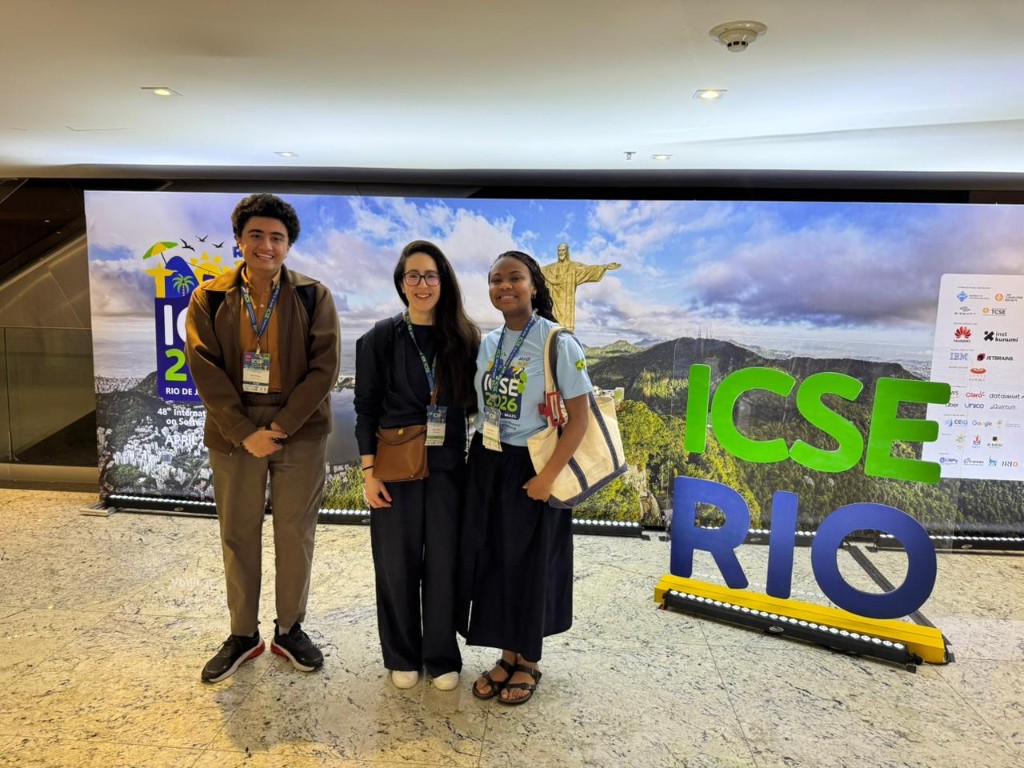
The MUSE Lab attended ICSE 2026 in Rio de Janeiro! We presented three papers across the Main Track, NIER, and CHASE.
Apr 2026
Dr. Guizani and Nathan Cassee organized a fishbowl-style panel at CHASE 2026 called "The Human Side of Developer Experience", bringing together researchers for an open discussion on human factors in software engineering.
Mar 2026
Three papers accepted at ICSE 2026! Our work on OSS4SG community patterns got into the Main Track, our collaboration on LLM-driven documentation translation into the NIER Track, and Aaliyah Chang's work on motivations in software engineering into CHASE.
Mar 2026
Our Community Tapestry dashboard was presented at SANER 2026 as part of the Journal First track. This tool helps open source project leaders track diversity and turnover in their communities.
Mar 2026
Dr. Guizani received funding from the Ontario Research Fund as part of Ontario's $47M investment in research and innovation, supporting our work on sustainable open source and developer productivity.
Feb 2026
Our systematic review on the impact of LLM assistants on developer productivity by Amr Mohamed, Maram Assi, and Mariam Guizani has been accepted at TOSEM.
Read the preprint
Nov 2025
Mohamad Ashraf presented our paper on reverse engineering user stories from code using LLMs at CASCON 2025 in Toronto.
Read the paper
Nov 2025
Michael Zhang presented our work on programming language topic classification at CASCON 2025 in Toronto.
Sep 2025
The MUSE Lab is welcoming international undergraduate students through the Mitacs Globalink Research Internship program for summer 2026.
Jul 2025
Dr. Guizani was voted the favorite 3rd-year professor in Electrical and Computer Engineering at Queen's and received the Undergraduate Teaching Award.
Jun 2025
Dr. Guizani received an NSERC Discovery Grant to develop actionable diversity and inclusion tools for socio-technically sustainable open source software.
May 2025
Dr. Guizani served as Media Co-Chair for CASCON 2025, the 35th anniversary of the IEEE International Conference on Collaborative Advances in Software and Computing.
Apr 2024
Dr. Guizani received the Frank Knox Award for Excellence in Teaching at Queen's University, recognizing her outstanding commitment to students.
Nov 2022
Our research on the Maintainer Dashboard helped inform the GitHub Discussions Dashboard and was featured on the GitHub blog. This work came out of Dr. Guizani's internship at Microsoft Research.
Sep 2021
Dr. Guizani was an invited speaker at the Open Source Summit 2021 in Seattle, organized by the Linux Foundation, where she presented on developer productivity in open source communities.